MCPwn (CVE-2026-33032): How One Missing Middleware Call Validated the MCP Threat Model
In April 2026, CVE-2026-33032 became the first widely-exploited Model Context Protocol vulnerability in the wild. Pluto Security codenamed it MCPwn. The mechanism was a single missing middleware call. V-Spot's research division on what it actually validates about MCP server security in production.
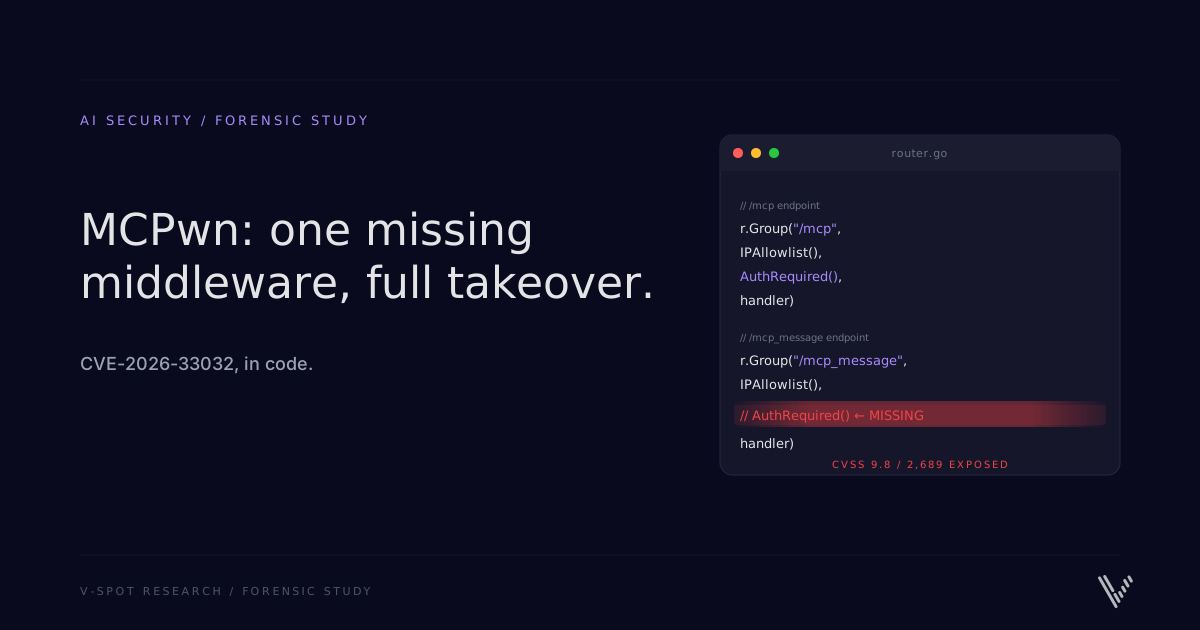
In April 2026, CVE-2026-33032 became the first widely-exploited Model Context Protocol vulnerability in the wild. Pluto Security codenamed it MCPwn. The technical mechanism was a single missing middleware call on a single endpoint of nginx-ui's MCP integration. The CVSS score is 9.8. Active exploitation hit roughly 2,689 internet-exposed nginx-ui instances by mid-April, and the bug was added to VulnCheck's Known Exploited Vulnerabilities catalogue on 13 April 2026.
What followed in the published advisories from Rapid7, Picus Security, The Hacker News, and Endor Labs was a textbook walkthrough of how a one-line bug becomes complete nginx-server takeover. What the advisories underweight, and what V-Spot's research division wants to put on the record, is that MCPwn is not an isolated nginx-ui story. It is the first widely-exploited expression of a structural authentication gap that more than thirty Model Context Protocol disclosures across the ecosystem have already foreshadowed.
This is V-Spot on what MCPwn actually means: the technical anatomy, the chain it sat in, the threat model it validates, and the practical work every team running MCP in production should be doing this week.
The vulnerability, in code
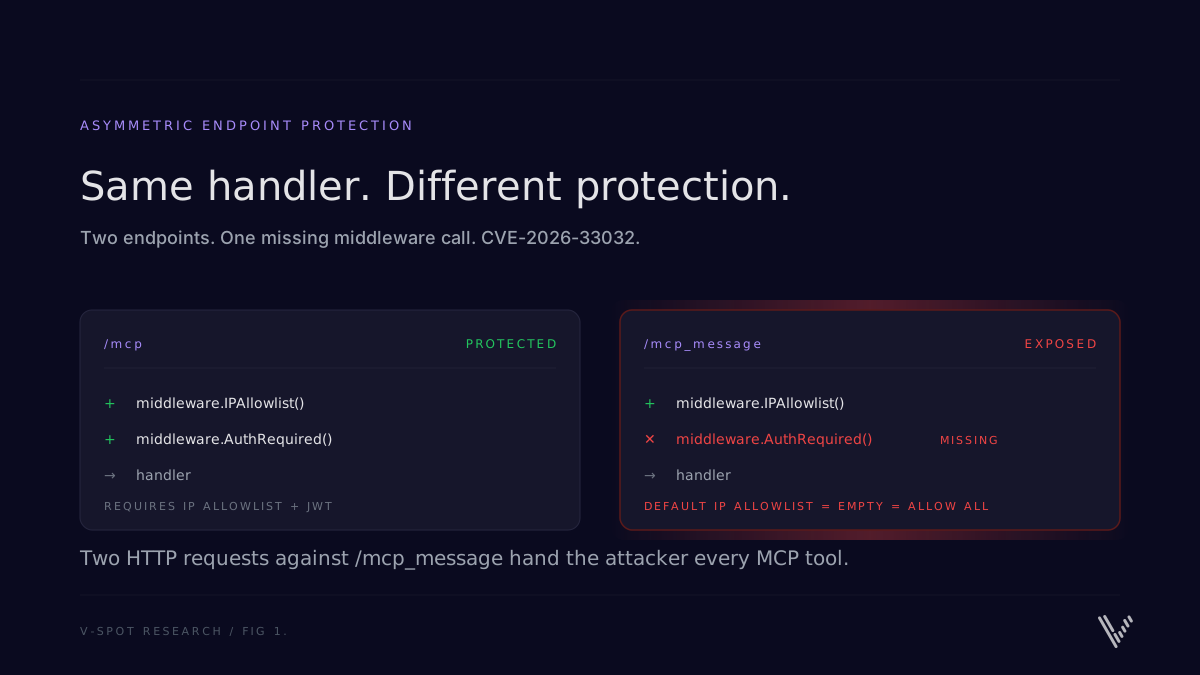
nginx-ui ships an MCP integration that exposes two HTTP endpoints. The shape of the bug is in the asymmetry between them.
The /mcp endpoint is registered with two pieces of middleware: an IP allowlist check and an authentication check (AuthRequired()). To invoke any of the twelve MCP tools that endpoint exposes, a client must satisfy both the network-level allowlist and the application-level credential.
The /mcp_message endpoint, which is the actual transport for tool invocations once a session has been negotiated, is registered with only the IP allowlist. The authentication middleware is missing.
// /mcp endpoint, correctly protected
r.Group("/mcp", middleware.IPAllowlist(), middleware.AuthRequired(),
  func() { /* handler */ })

// /mcp_message endpoint, missing AuthRequired
r.Group("/mcp_message", middleware.IPAllowlist(),
  func() { /* same handler */ })
That alone would be a serious bug. The configuration default makes it a remote-takeover bug.
The IP allowlist defaults to empty. The middleware that enforces it interprets an empty list as "allow all," not as "deny all." On a default nginx-ui install, the IP allowlist accepts every source address. Combined with the missing AuthRequired() call on /mcp_message, this means any network-reachable attacker can invoke any of the twelve MCP tools, with no authentication, in no more than two HTTP requests. The available tools include nginx_config_add (with auto-reload), nginx_config_modify, nginx_config_delete, and nginx_restart. Complete service takeover follows.
The patch in nginx-ui 2.3.4, released on 15 March 2026, is one line of Go: adding middleware.AuthRequired() to the /mcp_message registration. The recommended hardening, separately, is to flip the IP allowlist default from "empty equals allow all" to "empty equals deny all," which is the structurally safer interpretation regardless.
The chain that turned a one-line bug into mass exploitation
MCPwn is rarely exploited in isolation. The exploitation pattern observed in the wild chains it with CVE-2026-27944, an earlier nginx-ui vulnerability disclosed in March 2026.
CVE-2026-27944 is, on its own, a 9.8 of a different shape: the /api/backup endpoint accepted unauthenticated GET requests prior to nginx-ui 2.3.3, and the AES-256 encryption key needed to decrypt the resulting backup file was returned to the same caller in the X-Backup-Security response header. An attacker could request a full system backup, decrypt it on their own infrastructure, and extract every secret the application held in state, including the node_secret value that nginx-ui uses to authenticate inter-node MCP traffic.
With the leaked node_secret in hand, the attacker presents it as the X-Node-Secret header on a request to nginx-ui, receives a valid MCP session identifier in return, then uses that session against /mcp_message, where MCPwn means no further authentication check happens. Two requests in, the attacker can write any nginx configuration they want, with auto-reload, on a target they reached only because it was internet-exposed.
The instances that survived this chain are the ones that had upgraded to 2.3.3 (which fixed CVE-2026-27944) but not yet to 2.3.4 (which fixed MCPwn), and the ones whose IP allowlist was explicitly populated rather than left at the default. Both populations are smaller than the population of unattended nginx-ui boxes that had drifted on autopilot, which is why the Shodan-visible exploitation surface remained roughly 2,689 instances even after the patch landed.
Why this was inevitable
The Model Context Protocol shipped publicly in late 2024 and crossed the adoption inflection point in mid-2025. By Q1 2026, MCP servers had become the default mechanism for connecting agents to data, tools, and downstream APIs across the major commercial AI platforms. Slack agents, coding agents, customer support agents, internal-tooling agents: all of them increasingly load MCP servers at boot and call them at run time.
The protocol matured fast. The security ecosystem around it did not.
There is no widely-adopted authentication contract for MCP server endpoints. Each implementation defines its own. The patterns that have emerged are inconsistent and frequently broken. Token passthrough, where an MCP server accepts a JWT or session token from a calling agent without validating that the token was actually issued for the server, is widespread. Default-empty allowlists interpreted as allow-all, the precise misconfiguration MCPwn turned into a CVE, are common. MCP servers running as stdio subprocesses inside the agent's process (the StdioServerParameters pattern) inherit the agent's full credentials and network access without any additional check.
The disclosure record reflects this. Industry trackers count more than thirty MCP-related security disclosures so far in 2026, with at least ten assigned CVEs across multiple language ecosystems. MCPwn is the first of those to combine a high CVSS score, a wide deployment footprint, an obvious exploitation primitive, and a state-of-the-ecosystem profile that journalists could explain in a paragraph. It is the one that crossed into mainstream security press.
It will not be the last.
What MCPwn validates about the MCP threat model
V-Spot's research division published a position one week before MCPwn went mainstream: that MCP servers in 2026 sit at exactly the trust level npm packages sat at in 2018. The same pattern. Useful protocol, low barrier to entry, fast ecosystem growth, implementation footguns becoming attack surface, and one early major CVE that crystallises the threat model for everyone else.
MCPwn is that CVE.
What is materially different between npm-2018 and MCP-2026, and worth saying clearly because it shapes the defensive posture: MCP servers operate at higher privilege than the npm packages of seven years ago. An npm package executes within an application process at the privilege of whoever ran npm install. An MCP server runs as part of an agent's runtime, with delegated trust to invoke tools, read context windows, write to memory stores, and call external APIs on behalf of users who never explicitly approved it as a capability. The blast radius per malicious component is larger, and the audit trail is, in most current implementations, weaker.
The other consequential difference: deployment surface. By the time npm crossed into "every JavaScript shop loads it" territory, the security industry had a decade of operating-system supply-chain experience to draw on. MCP has crossed into "every commercial agent platform loads it" inside eighteen months, and the security industry is constructing its threat models in real time. MCPwn is the moment the construction stops being theoretical.
The four-question MCP server review
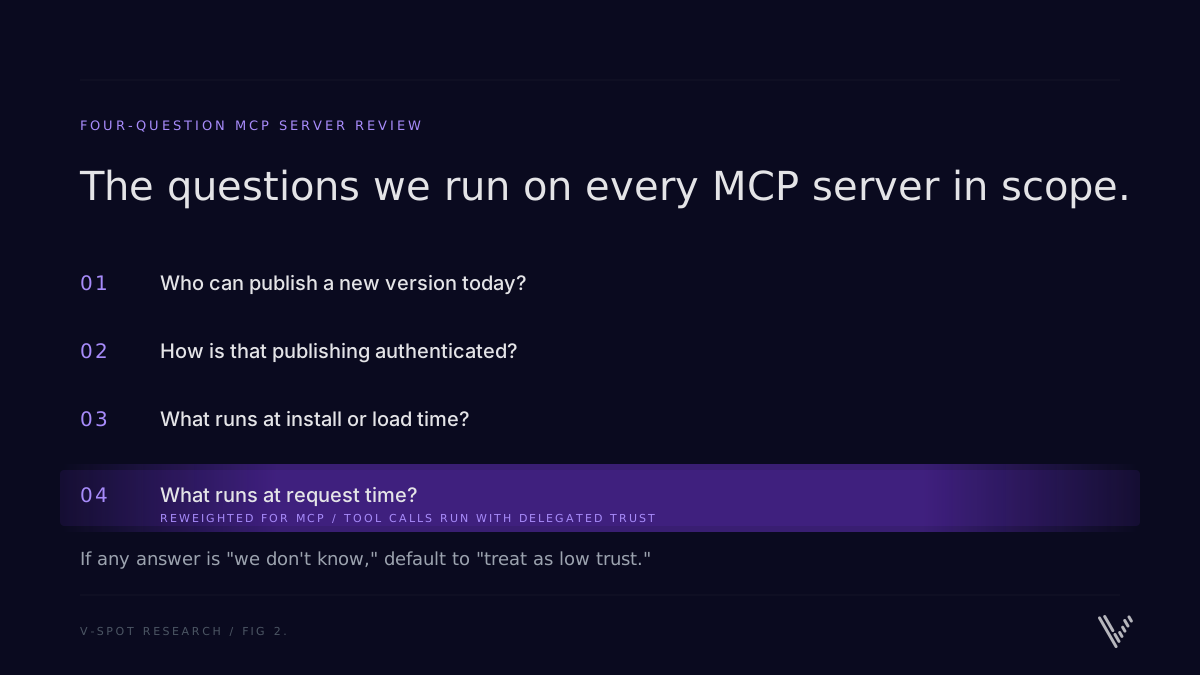
The framework V-Spot published for npm dependencies last month adapts cleanly to MCP servers, with the fourth question reweighted. The same four questions, applied to every MCP server in scope on a security review:
1. Who can publish a new version of this MCP server today? Count the human accounts and CI workflows with publish authority for this server, in whatever ecosystem it ships through (npm, PyPI, Smithery's MCP registry, a private repo). One or two individuals on personal credentials is the integrity boundary.
2. How is that publishing authenticated? Hardware-backed 2FA? OIDC trusted publishing? OTP-only? "We do not know" defaults to "treat as low trust."
3. What runs at install or load time? For MCP, this is broader than npm: it includes the server's bootstrap when the agent loads it, any environment-variable or configuration reads, and any network calls the server makes during initialisation.
4. What runs at request time? This is the question that changes the most for MCP. Tool invocations are the meaningful primitive. Each invocation runs with the trust the agent extended to the server: read context, write to memory, call out to external services. A malicious or compromised MCP server can manipulate every tool response to steer the agent's downstream decisions, which is not a threat model that exists for a passive npm dependency.
For each MCP server your team has loaded, these four questions get answered, and the answers get written down somewhere a person can read in twelve months without re-deriving them.
What every team using MCP servers should do this week
A practical list. The first three are urgent if your environment touches nginx-ui at all.
Audit nginx-ui exposure now. Run an internal scan or check Shodan for any nginx-ui instance your organisation operates. Anything below 2.3.4 is unsafe. Patch immediately. If patching cannot happen in the next 24 hours, take the instance off the internet, then patch.
Confirm the IP allowlist on every nginx-ui instance is explicitly populated, not left empty. Even patched instances on 2.3.4+ benefit from defence-in-depth here. The misinterpretation of empty-as-allow-all has been documented across the ecosystem; the right configuration posture is explicit allowlists.
Hunt for MCP-related anomalies in the previous 30 days. If MCPwn was exploited against your environment between mid-March and mid-April, the attacker likely modified an nginx configuration, restarted nginx, or both. Pull configuration history, restart logs, and any nginx error logs. Look for nginx_config_add patterns that did not originate from your change-management system.
Apply the four-question review (above) to every other MCP server your team has installed, not just nginx-ui's. The MCPwn pattern, missing authentication on a privileged endpoint, is structurally common across the ecosystem.
Restrict egress from MCP server hosts. A malicious MCP server in your environment phones out somewhere when it operates. Egress allowlisting, restricted to the registries, APIs, and downstream services the server legitimately needs, closes a substantial fraction of the post-exploitation surface.
Add tool-call provenance logging. The Article 13 transparency requirements that apply to high-risk AI systems under the EU AI Act apply here too: which MCP server was consulted, what it returned, and why the agent acted on the return. If you are not logging this, MCPwn-class incidents in your environment will not be reconstructable when a regulator or an incident-response team asks.
Tabletop the scenario. Thirty-minute exercise. "We discover that an MCP server one of our agents depends on was backdoored 48 hours ago. Walk through the next eight hours." Most teams find gaps the first time they try this. The cost of finding them in an exercise is meaningfully lower than finding them in a real incident.
What comes next
Two predictions V-Spot's research division will stand behind.
Within six months, a state-sponsored actor will exploit a less-popular MCP server in a targeted campaign. The pattern from npm holds: once a class of supply-chain primitive is publicly weaponisable, the major actors who already operate at this layer (UNC1069, the broader DPRK supply-chain cluster, comparable operators in other states) will move into it. They will not pick the most popular MCP server. They will pick the one that has the deepest access to the most sensitive target, ship a quiet backdoored version, and let the agent ecosystem deliver it.
Within twelve months, a publicly-disclosed breach at a major commercial AI agent platform will be attributed to a malicious or compromised MCP server in its supply chain. The probability of this is high enough that organisations shipping agents into regulated industries should be threat-modelling for it now, not after the disclosure.
The broader trajectory is that MCP-specific tooling, the equivalent of Socket or Snyk Advisor for npm but operating against MCP server registries, becomes standard infrastructure within eighteen months. Any team currently shipping agents into production should expect the cost of this tooling to fall and the necessity of operating it to rise on the same curve.
Closing
The MCPwn patch is one line of code. The lesson around it is the bigger thing.
MCP servers are infrastructure now. They get reviewed, deployed, and operated under the same discipline the rest of the production stack is operated under, or they become the next supply-chain weakness state-sponsored actors exploit at scale. There is no third path. The npm trajectory of the past seven years exists as the historical reference, and MCP is repeating it on a faster clock and at higher privilege.
If you are mid-response on MCPwn, or auditing MCP servers across your stack, V-Spot's research division and offensive security team can help. We are tracking this ecosystem closely.
MCPwn sits inside the broader V-Spot TeamPCP research series, which tracks the threat actor cluster active across the 2026 npm and PyPI supply chain attacks. For the methodology applied to dependency reviews across our briefs, see the V-Spot four-question dependency review.
---
Sources:
- CVE-2026-33032: Nginx UI Missing MCP Authentication, Rapid7
- CVE-2026-33032 (MCPwn): How a Missing Middleware Call in nginx-ui Hands Attackers Full Web Server Takeover, Picus Security
- Actively Exploited nginx-ui Flaw (CVE-2026-33032) Enables Full Nginx Server Takeover, The Hacker News
- CVE-2026-33032: nginx-ui's Unauthenticated MCP Endpoint Allows Remote Nginx Takeover, Endor Labs
- CVE-2026-27944: Critical Nginx UI flaw exposes server backups, Security Affairs
- CVE-2026-27944: Unauthenticated backup download and encryption key disclosure in Nginx UI, IONIX
- A Timeline of Model Context Protocol (MCP) Security Breaches, Authzed
- Plug, Play, and Prey: The security risks of the Model Context Protocol, Microsoft Defender for Cloud