What the Axios Advisories Aren't Telling You About npm Supply Chain Risk
The 31 March Axios npm compromise produced a wave of standard hardening advice: block postinstall, audit dependencies, rotate tokens. V-Spot's research division on what most of those checklists miss, the detection-versus-exposure gap that defines 2026 supply chain risk, and a tactical playbook for what actually holds.
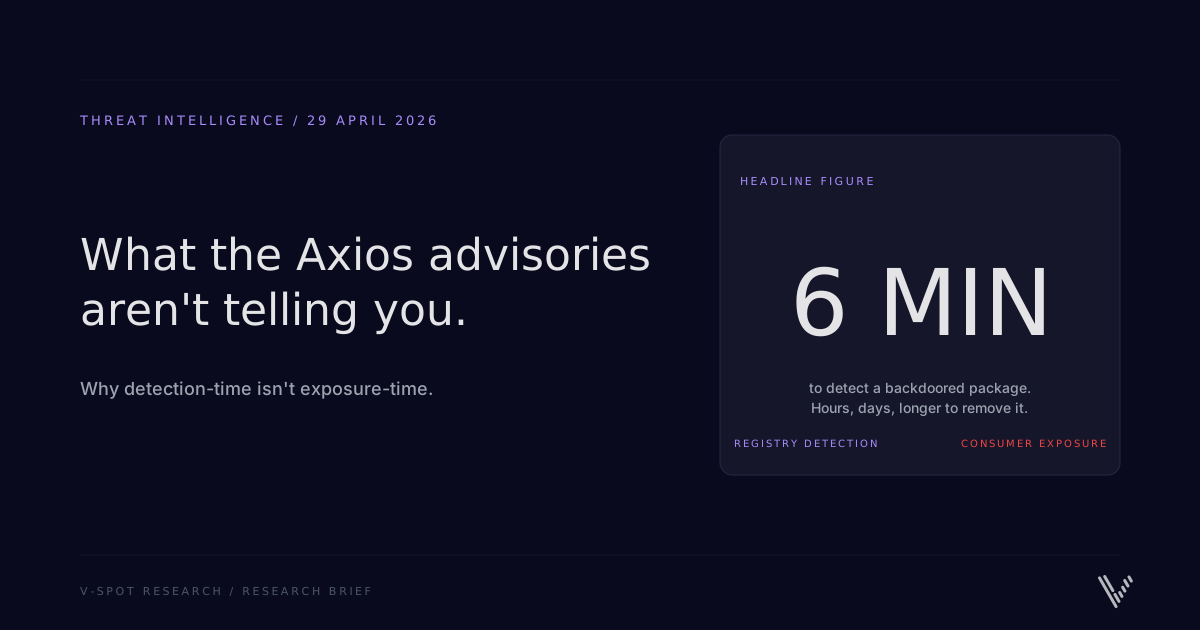
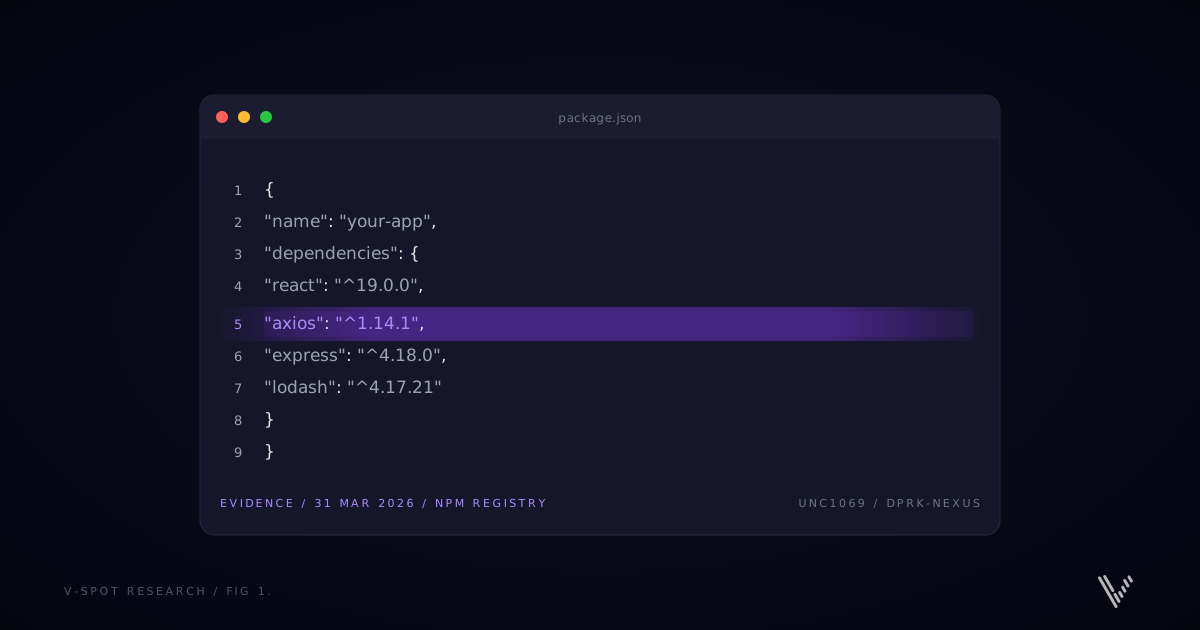
On 31 March 2026, two backdoored versions of Axios, one of the most-installed JavaScript HTTP libraries on npm with over 70 million weekly downloads, were published to the registry by a hijacked maintainer account. Google Threat Intelligence has attributed the attack to UNC1069, a North Korea-nexus actor active since 2018.
The wave of hardening advice that followed (see published advisories from Microsoft, Google Threat Intel, and CISA) converged on the same checklist: block postinstall scripts, audit your dependency tree, rotate compromised credentials, enable 2FA. All of that is correct. None of it is enough. This is V-Spot's research division on what the standard advice misses, the structural reason it keeps missing it, and a tactical playbook teams can run this week.
The detection-versus-exposure gap
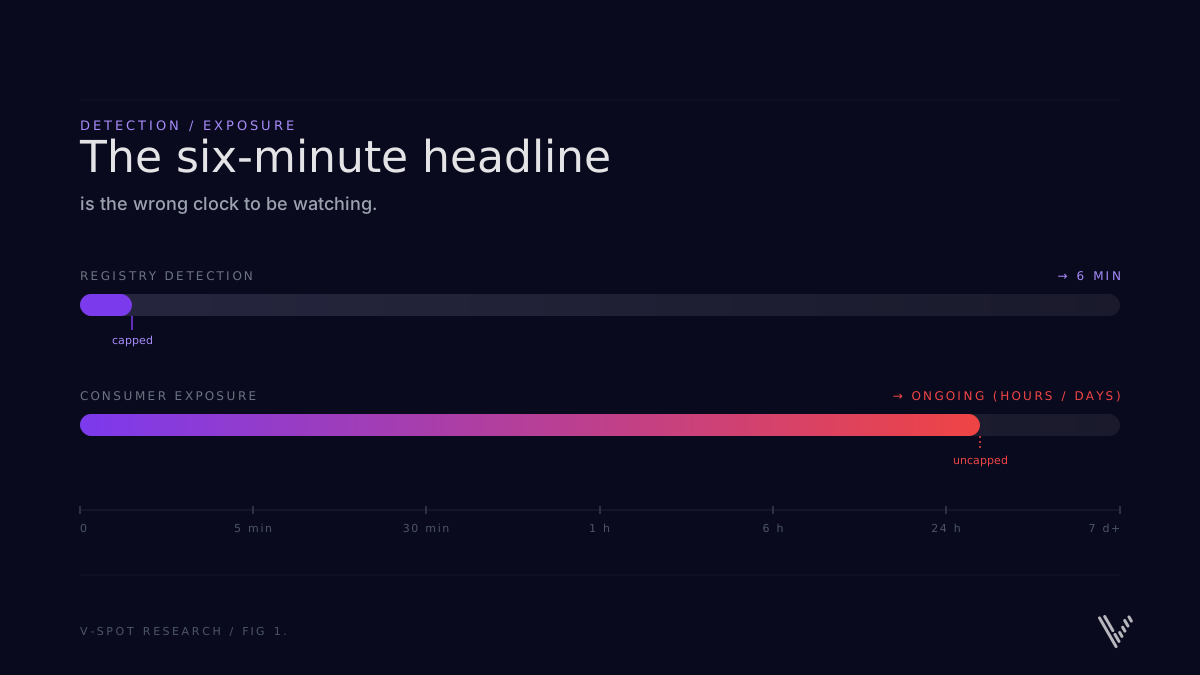
The headline statistic from the Axios incident is that Socket flagged the malicious transitive dependency within roughly six minutes of publication. That number has been repeated across reporting as a sign the ecosystem is healthier than it used to be. It is also the most important misframing in the entire response.
Detection time at the registry side is not the same as exposure time at the consumer side. Those two clocks run independently.
Six-minute registry-side detection only matters if every consumer of the package re-resolves their dependency tree only once that detection has propagated. In practice, your CI runs against every pull request. Your developers run npm install on a fresh checkout whenever they switch branches. Your container builds pull from npm at every image rebuild. Each of those events is a potential exposure window, decoupled from the detection event entirely.
The relevant defensive question is not *how fast did the registry community catch this?* It is *how many install events did your fleet run during the window between malicious publication and your tooling actually refusing to install the bad version?*
For most organisations the honest answer is: we have no idea, because we have no telemetry on it. Detection is on someone else's roadmap. Exposure is the metric we should care about, and it is one we control, but not with the standard advisory checklist.
The defensive implication is structural: the only reliable supply chain control is one that runs on the consumer side, on every install, against a policy you own. Registry-side detection is a strict subset of what you need.
Where the standard advice falls short
Three specific gaps appear in most of the public advisories from the past month.
"Block postinstall scripts": works in theory, breaks in practice
npm install --ignore-scripts (or ignore-scripts=true in .npmrc) is the canonical recommendation. It is also the recommendation most teams revert within a week of trying.
The problem is that several legitimate, widely-used packages depend on postinstall for native binary fetching: sharp, esbuild, lefthook, husky, cypress, several Tailwind binaries, and a long list of others. Blanket --ignore-scripts causes silent or noisy build failures that take hours to diagnose, especially on first-time installs in CI.
The advisories rarely tell you what to do about this. The actual tactical answer is selective allowlisting via a deny-by-default install plus a small set of trusted exceptions, executed in an ephemeral, sandboxed environment. That is a meaningfully different control than just flipping a flag, and it is the bar V-Spot recommends to its engagements:
# In .npmrc: deny by default
ignore-scripts=true

# Wrap install in a controlled environment for the genuine exceptions
# Run in a sandboxed container with no network access except to npm
npm install --include=optional --ignore-scripts
# Then run the trusted scripts manually, with audit logging
npm rebuild sharp esbuild lefthook
A package that needs to run code on install is, structurally, requesting arbitrary code execution on every machine that installs it. The right policy is to recognise this and treat each postinstall-using dependency as an explicit, reviewed trust grant, not as a default that gets disabled and then quietly re-enabled when builds break.
"Audit your dependency tree": most teams are running the wrong audit
npm audit checks for known CVEs. It is a vulnerability scan against a database of disclosed weaknesses. It is not a malware scan. The Axios compromise, and every supply chain attack of the past three years, would not be flagged by npm audit until well after the fact, because at the time of publication there is no CVE to match against.
Yet a substantial fraction of teams treat passing npm audit as their supply chain control. The advisories rarely correct this misconception. Three controls genuinely belong in this slot:
1. A malware-aware SCA tool (Socket, Snyk Advisor, Aikido, GitHub's npm package security signals). These detect behavioural anomalies (install-time network calls, suspicious obfuscation, unusual dependency churn) independently of CVE matching.
2. Lockfile diff review. A pull request that changes package-lock.json should be code-reviewed by a human who looks specifically at *what was added or upgraded* and asks whether that change is expected. Most teams skim lockfile diffs because they are large and noisy. The Axios change would have been visible to a careful reviewer because of the new plain-crypto-js entry, a name nobody on the team would have recognised. Plenty of teams have process for code review and zero process for lockfile review.
3. Provenance verification. npm now supports package provenance (--provenance) tied to GitHub Actions or other trusted CI workflows. Consumers can verify, at install time, that a package was built by the workflow it claims. This is genuinely new infrastructure, and the advisories underweight it.
"Rotate compromised credentials": necessary, but reactive
Every advisory ends with credential rotation. Correct, and important. But credential rotation is post-incident remediation, not prevention. The preventive equivalents, which the advisories mention briefly or not at all, are:
- Hardware-backed 2FA enforcement on every npm publishing identity, with no SMS fallback. The Axios maintainer compromise was, by the public reporting, a credential compromise on the publishing account. Hardware-key 2FA renders that class of attack significantly harder.
- Granular publish tokens scoped per-package and per-CI workflow, not personal access tokens with global scope.
- Trusted publishing via OIDC. This is the real long-term answer: the package is published by a CI workflow with an attestable identity, not by a human with a credential. The Axios incident would not have been possible against a project using OIDC trusted publishing.
These are infrastructure choices that take days to weeks to roll out across an organisation. They are also the only category of control that addresses the root cause rather than the symptom.
V-Spot's four-question supply chain threat model
The published advisories address tactics. They do not give the reader a framework to reason about supply chain risk on the *next* incident, which will look different. V-Spot's research division uses four questions, applied to every direct and transitive dependency in scope on a security review:
1. Who can publish a new version of this package today? *Count the human accounts and CI workflows with publish authority. If the answer is one or two individuals on personal credentials, that count is the integrity boundary of every consumer.*
2. How is that publishing authenticated? *Hardware 2FA? OIDC? OTP-only? Personal access token? The strongest-sounding answer for an unfamiliar package is "we don't know"; and "we don't know" should default to "treat as low trust."*
3. What runs at install time? *postinstall, preinstall, install, prepare. Any of these is arbitrary code execution. A package with no install-time scripts is structurally lower-risk than an otherwise-identical package with one, regardless of code quality.*
4. What runs at runtime? *Network calls, file system access, child processes, dynamic imports. A simple utility package that suddenly grows a network-call dependency in a minor version is a question that needs to be asked, not a quiet upgrade.*
These four questions do two useful things. They give a reviewer a structured way to triage a 2,000-package dependency tree (the high-impact packages, those failing #1 or #3, are a small subset of the total). And they provide a vocabulary that applies cleanly to the next incident, whether it appears on npm, PyPI, RubyGems, Maven, Cargo, or wherever the supply chain frontier moves to next.
A tactical playbook teams can run this week
Specific, copy-pasteable. Adapt to your stack.
CI configuration
# .github/workflows/ci.yml: install step (excerpt)
- name: Install dependencies (sandboxed)
  run: |
    # Use npm ci against a committed lockfile, not npm install
    # --ignore-scripts is the floor, not the ceiling
    npm ci --ignore-scripts
- name: Run trusted postinstall steps explicitly
  run: |
    # Document and audit the allowlist; review it on every PR that adds to it
    npm rebuild sharp esbuild
- name: Verify package provenance
  run: |
    # For packages that publish provenance, fail the build if verification fails
    npm install --foreground-scripts=false --verify-deps-info
Network egress controls on CI runners
Most CI runners need to talk to: your registry, your VCS, and your deployment target. A postinstall script that calls home needs internet access to *something else*. Egress allowlisting on the runner (at the network policy level if you self-host, or via the platform's egress controls if you do not) closes the entire class of "package phones home on install." This is one of the highest-impact, lowest-cost controls available, and it is rarely in the standard advisories.
Lockfile review as a code-review primitive
Add a CI check that comments on every PR which changes package-lock.json, summarising what changed: which packages were added, which were upgraded across a major or minor boundary, which gained or lost transitive dependencies. The mechanism is mechanical; the human review takes seconds for a normal change and prompts attention for anything unusual. Several open-source actions implement this; the cost is roughly an afternoon of integration work.
Internal package hygiene
For any internal npm package your organisation publishes:
- Hardware-backed 2FA on every publisher identity. No SMS fallback. No exceptions.
- Provenance enabled on every published version (
npm publish --provenancefrom a CI workflow, not from a developer machine). - Automated re-issue of publish tokens on a schedule, not on demand.
- A documented playbook for "we believe a maintainer credential is compromised" that includes how to lock the package, who is authorised to do so, and how the lock is communicated to consumers.
Endpoint hardening for developers
A developer laptop pulls dependencies, signs commits, holds cloud credentials, and frequently sits inside the trust boundary of production. Treat the laptop accordingly: EDR with behaviour analytics, application-isolation primitives where the platform offers them (Apple's transparency/consent framework, Windows AppContainer, Linux user namespaces), restricted shell history capture, and clear escalation when anomalous install-time behaviour is observed.
What V-Spot's research division expects next
Looking at the broader operational pattern across UNC1069, Sapphire Sleet, and TraderTraitor over the past 18 months (consistent with the threat-landscape shifts we tracked in our 2026 ransomware brief), two predictions look defensible.
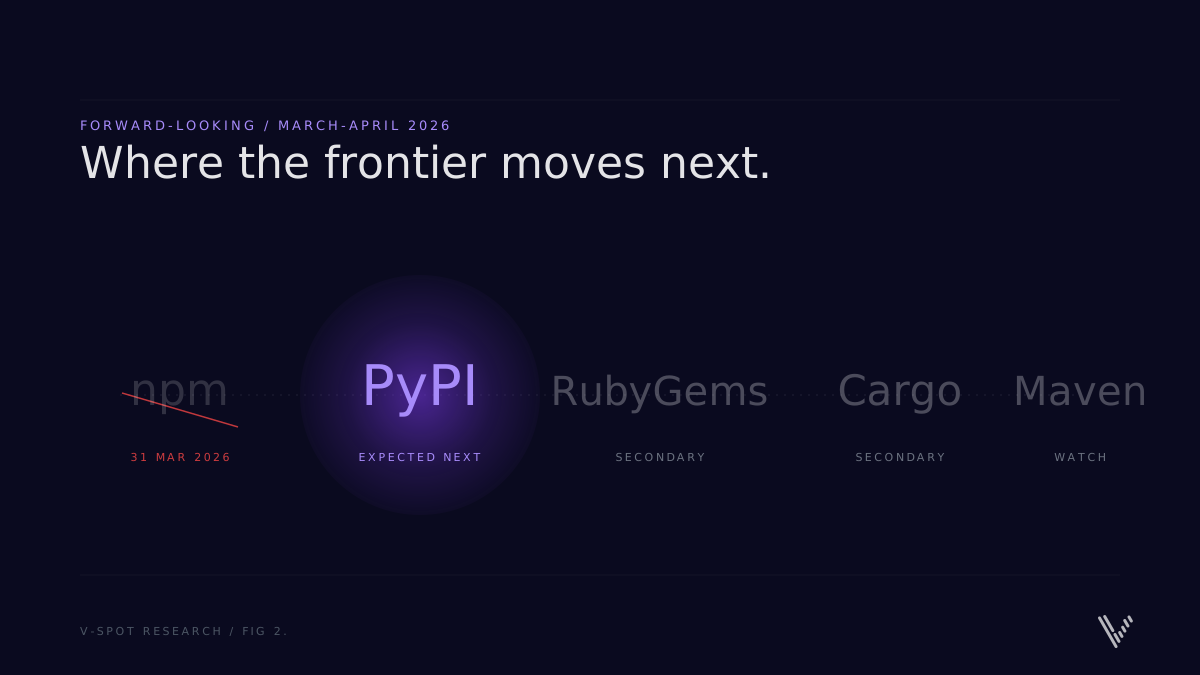
Expectation 1: the next compromise will not be on npm. The same operational tradecraft works against every registry that combines a maintainer-credential trust model with install-time scripting. PyPI is the most natural next target: it has a comparable surface area, weaker average maintainer-account hygiene, and a history of similar compromises. Watch RubyGems and Cargo as secondary candidates.
Expectation 2: the on-install payload will get quieter. The Axios payload was caught in six minutes because it called home from a postinstall script, a signal that automated registry scanners now reliably flag. The next-generation payload will likely defer the network call to runtime, gated by environment characteristics (specific environment variables, specific user contexts, specific times-of-day). That defeats install-time behavioural detection. The defensive answer is the same (runtime egress controls and runtime EDR), but the registry-side detection that featured in the Axios response will be less effective.
For organisations that have run their Axios response and are wondering what comes after, those two expectations are where to invest. The investment that pays back across both is the same: assume the consumer-side controls are the only ones you can rely on, and harden accordingly.
Closing
The standard advisories from the Axios incident are correct as far as they go. They go halfway. The other half is structural: consumer-side controls, a stable threat model that survives the next incident, and concrete technical configurations rather than checklist platitudes. That second half is the work that has to live inside your organisation. The advisories will not write it for you.
If you are mid-response on the Axios incident, or rebuilding your supply chain posture more broadly, V-Spot's research division and offensive security team can help. We bring the second half.
The Axios brief is the first in V-Spot's TeamPCP research series, where we continue to track the actor cluster behind this compromise across subsequent incidents. The methodology applied to the response above is the V-Spot four-question dependency review.